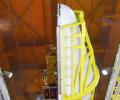
PSLV-C51/Amazonia-1 is the first dedicated commercial mission of NewSpace India Limited, Indian Space Research Organisation's commercial arm.

Describing the failure of the GSAT-5P communication satellite launch on Saturday as 'very tragic', India's top space scientists and strategic thinkers said the launch vehicle going up in flames soon after the lift off was 'a major setback' for ISRO. Senior space scientist Professor Yashpal, in his first reaction to the failure of the satellite launch, said, "It is very tragic. I think something has happened in early stages. I have never heard of such a thing."

The SSLV is designed to be affordable and amenable to industry production and aimed to function as a launch-on-demand platform for mini, micro or nano satellites.

The Indian Space Research Organisation has resolved to alight its lander on the lunar surface with Chandrayaan-3 in addition to a maiden solar expedition in 2020.

ISRO needs next generation launchers and new facilities to manufacture and launch them.

And the first Indian to go into space from 'Indian soil' could well be a woman.

United States President Donald Trump on Tuesday (local time) reiterated his opposition to electric vehicle (EV) mandates, criticising government subsidies for Tesla CEO Elon Musk and questioning the broader push for EV adoption in the United States.

Just over 22 minutes into the flight, the rocket put Astrosat into orbit at an altitude of 650 km above the earth

Starlink's application for offering satcom services in India had been held up for the company's inability to comply with mandatory ownership disclosure norms.
GSLV-MK III, which uses a homegrown cryogenic engine, has to do at least two more launches before it begins commercial operations, report Raghu Krishnan and T E Narasimhan.
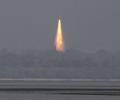
Indian Space agency Indian Space Research Organisation would launch the Geo-synchronous Satellite Launch Vehicle-Mark III (LVM3 X mission) on December 18 which would carry active solid boosters, liquid core stage and a passive cryo-stage.
ISRO plans to launch 720-kg SPOT-6 remote sensing satellite from France (built by ASTRIUM SAS) and a 15-kg Japanese spacecraft Protiers on board the home-grown Polar Satellite Launch Vehicle (PSLV-C21) in the second week of September, in a major milestone of sorts.

India is set to operationalise its own navigational system with the successful launch of IRNSS-1D, the fourth in the series of seven navigational satellites, onboard PSLV-C27 from Sriharikota on Saturday.

A truly 'made in India' satellite that will empower a digital India.

K Sivan has to hasten the effort to bring in private players into satellite and rocket building and replicate India's software success in aerospace.

Weighing about 5,854 kg, GSAT-11 would play a vital role in providing broadband services across the country, and also provide a platform to demonstrate new generation applications.

India's heaviest rocket ever is expected to take to the sky next January on an experimental flight whose later versions could be used to send humans on space missions.

India's Mars Orbiter Mission is slated to be launched on October 28 after a national committee of experts gave the go ahead for the Rs 450 crore ambitious venture after threadbare deliberations.

The 43.43 metre tall rocket lifted off at 5.28 pm from the second launch pad at the Satish Dhawan Space Centre in Sriharikota
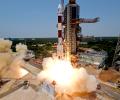
The successful launch of Aditya-L1 - the country's maiden mission to study the Sun - is expected to garner increased investor interest in the Indian space sector and trigger more funding for private players. Several private sector players, including Larsen & Toubro (L&T), MTAR Technologies, and Ananth Technologies, have played a pivotal role in the Indian Space Research Organisation's (Isro's) solar observatory mission. Aditya-L1 on Saturday set off on a 125-day journey on a PSLV-C57 rocket, in its attempt to study various elements relating to the nearest star from the halo orbit around Lagrange point 1 (L1) of the Sun-Earth system, which is about 1.5 million km from Earth.

Dr Rao accelerated the development of rocket technology which led to the successful launch of ASLV and PSLV satellites.
ISRO's Polar Satellite Launch Vehicle-C6, carrying India's remote sensing satellite CARTOSAT-1 and a micro satellite HAMSAT, blasted off from the Satish Dhawan Space Centre in Sriharikota on Thursday.
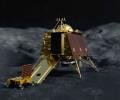
A number of private companies have contributed to the development of ISRO's Chandrayaan-3 spacecraft which successfully landed near the south pole of the Moon on Wednesday evening.

Launched on September 23, 2009 using the Polar Satellite Launch Vehicle from Sriharikota, Oceansat-2; is designed to provide service continuity for operational users of the Ocean Colour Monitor (OCM) instrument on Oceansat-1. The agreement with the Indian Space Research Organisation will lead to the use of data from Oceansat-2 for various US agencies for research, education and other activities of public good, including weather forecasting.

The Indian Space Research Organisation on Wednesday placed in orbit seven satellites including Oceansat-2 within a span of 20 minutes, its first successful mission after the abrupt end of the ambitious Chandrayaan-I project.

According to ISRO officials, the spacecraft will be placed in a halo orbit around Lagrange point 1 (L1) of the Sun-Earth system, about 1.5 million km from the Earth. The L1 point is about one per cent of the total distance between the Earth and the Sun.
The Indian Space Research Organisation will launch ten satellites, including eight from abroad, which will be carried by PSLV-C9, on April 28.The cluster of satellites to be lifted includes the Indian satellite Cartosat-2A, weighing 690 kg. The vehicle would also carry eight nano satellites of 16 to 27 kg from Canada, Netherlands, Denmark and Germany. Of the eight nano satellites, six are form a cluster called NLS-4. These satellites were built to test nano technoloy.

'Today onwards, the onboard thrusters will be fired and Chandryaan-3 will be taken away from Earth for an eventful landing on Moon's surface on August 23'
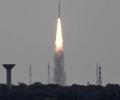
The space agency has set 2020 as the deadline for the first privately built rocket to be launched into space.

ISRO Chairman K Sivan said there might by a postponement if the weather was not conducive.
The satellite was placed at 4.18 pm, a little over 17 minutes after the Geosynchronous Satellite Launch Vehicle (GSLV-F-01) carrying it was launched from the Satish Dhawan Space Centre in Sriharikota.
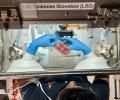
The $1.2 billion in-space manufacturing market is expected to grow and be worth more than $20 billion by 2033.

The Indian Space Research Organisation (ISRO) will perform the final manoeuvre on Saturday to inject Aditya-L1 spacecraft -- the first space-based Indian observatory to study the Sun -- into its final destination orbit, some 1.5 million kilometres from the Earth.
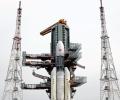
The Indian Space Research Organisation has released the first images of India's heaviest rocket, referred to as "Bahubali" days before it ferries India's Chandrayaan-2 into space. India's most ambitious space mission yet, Chandrayaan-2, which aims to place a robotic rover on the moon, will be launched on July 15 at 2:51 am. Here's all you need to know about the rocket.
The 44 metre tall four-stage PSLV placed Italian satellite AGILE into orbit at 550 km above the earth.

As India's first solar exploration satellite reached space, four Kerala public sector undertakings, including Keltron, have reason to be delighted as they too have contributed to this achievement by the country. Various products indigenously developed and manufactured by the four PSUs - Keltron, Steel and Industrial Forgings Limited (SIFL), Travancore Cochin Chemicals (TCC) and Kerala Automobiles Ltd (KAL) - have been used in the Aditya L1 mission. This milestone achieved by the PSUs was highlighted by state Industries Minister P Rajeev in a Facebook post.
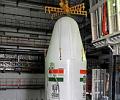
The launch of a Geosynchronous Satellite Launch Vehicle was called off by the Indian Space Reasearch Organisation at the eleventh hour on Monday due to a fuel leak in its second stage -- in a setback to the mission to test its homegrown cryogenic engine -- after its failure three years ago.
European instruments would be included on board India's mission to the moon, Chandrayaan-1, to be launched by India's Polar Satellite Launch Vehicle.
